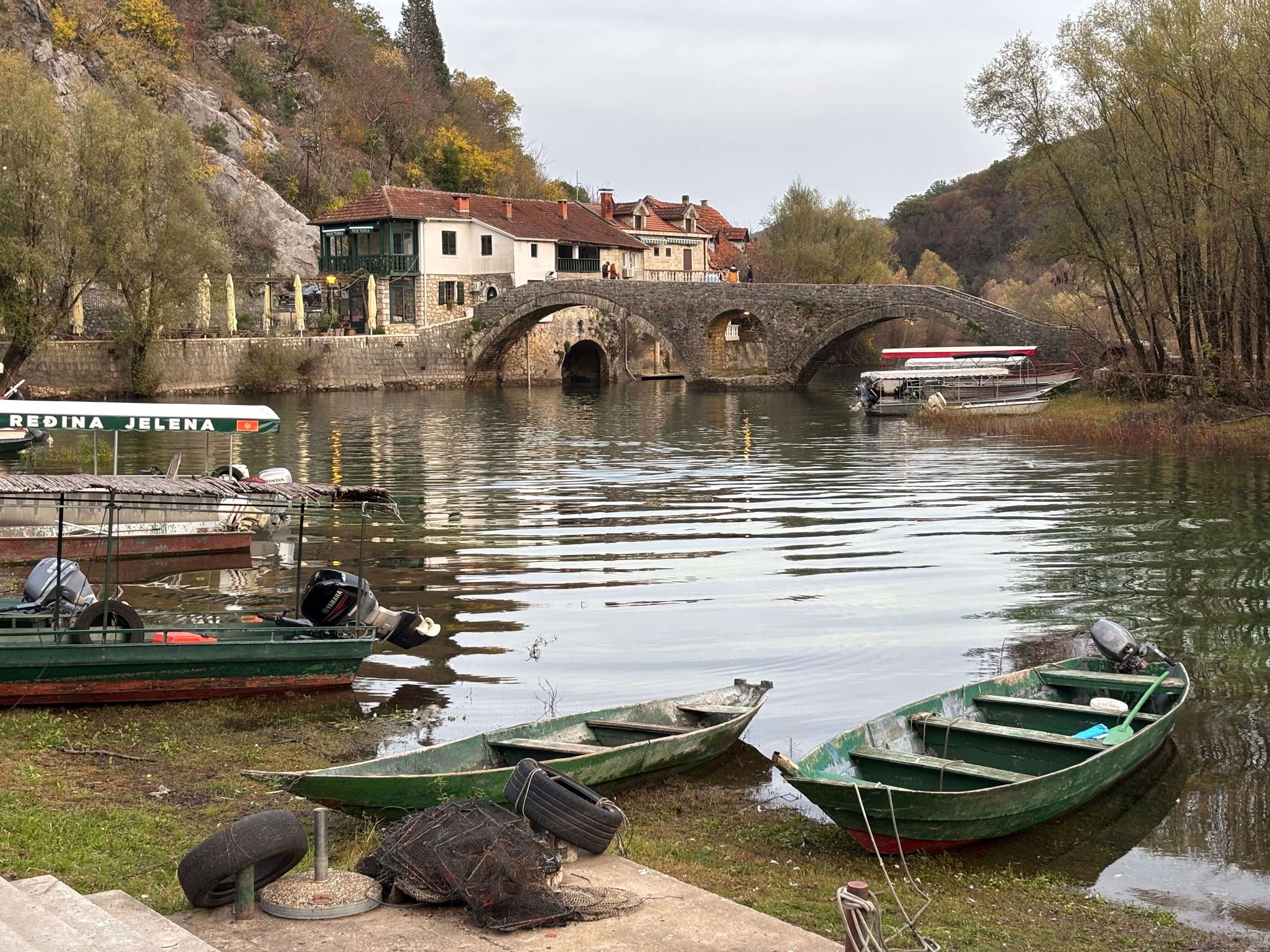
A tiny town on the shores of Lake Skadar holds the memory of medieval Zeta, a great printing press, and the turbulent centuries that forged the Montenegrin identity.
Nestled where a green river slides quietly into the mirror of Lake Skadar, Rijeka Crnojevica looks today like little more than a picturesque Montenegrin village — a stone arch bridge, a scattering of old walls, a handful of houses. Yet this modest place was once the beating heart of a principality that resisted the Ottoman tide, nurtured one of the earliest printing presses in the South Slavic world, and gave Montenegro its most enduring dynastic name.
Origins and the landscape of Zeta
The settlement grew in a landscape that had sheltered human communities since antiquity. The surrounding region of Zeta — the heartland of what would become Montenegro — was inhabited by Illyrian tribes before Roman legions arrived, then absorbed into the Byzantine sphere, and later contested by rival medieval kingdoms. By the high Middle Ages, Zeta had emerged as a distinct polity under local lords, a territory whose rugged mountains and sheltered lakeshores made it simultaneously difficult to conquer and valuable to hold.
The river that gives the town its name — Rijeka Crnojevica, "the river of the Crnojevici" — flows south from the hills of Old Montenegro into the great shallow basin of Lake Skadar, the largest lake on the Balkan Peninsula. This geography was decisive: the lake provided fish, the river a corridor inland, and the surrounding wetlands a natural defensive moat. For a ruling family seeking a secure seat of power, the site was close to ideal.
The rise of the Crnojevici dynasty

The Crnojevici family emerged as the dominant force in Zeta during the fourteenth and fifteenth centuries, as the medieval Serbian state crumbled under pressure from the advancing Ottoman Empire. While larger Serbian lords fell one by one to the Ottoman tide following the catastrophic Battle of Kosovo in 1389, the Crnojevici used the mountains of Zeta as a natural fortress, maintaining a precarious but real independence.
Stefan Crnojevici (died c. 1465) consolidated the family’s position and established Rijeka as a key administrative centre. It was his son, however, who would elevate both the town and the dynasty to lasting fame.

Ivan Crnojevici transformed a remote lakeside settlement into the cultural and political capital of a state that dared to outlast the Ottoman advance — for a generation, at least.
Medieval Balkan history
Ivan Crnojevici, who ruled Zeta from approximately 1465 to 1490, was one of the most formidable statesmen of his era in the Western Balkans. He rebuilt the fortress of Zabljak Crnojevica on a lake island, negotiated shrewdly with Venice — which controlled the Adriatic coast — and drew the borders of his principality with a careful eye. When the Ottomans seized Shkodra in 1479, Ivan retreated deeper into his mountain stronghold, fortified Rijeka Crnojevica as a centre of administration, and continued to rule an effectively independent Zeta. He is remembered in Montenegrin tradition as a founding figure of national identity, and his name lives on in the town itself.
The printing press: a revolution on the lakeshore
The most extraordinary chapter in Rijeka Crnojevica’s history belongs not to Ivan but to his son, Duradj Crnojevici (also known as Duradj II). In 1493, Duradj established a printing press at the nearby site of Obod — part of the broader area under the Crnojevici seat — making it one of the very first printing operations in the entire South Slavic world, appearing mere decades after Gutenberg’s press had transformed European civilization.
The Crnojevica printing press at Obod produced the Oktoih (Octoechos) — a liturgical book of eight tones used in Orthodox church services — on January 4, 1494. Printed in Church Slavonic with Cyrillic script, it is among the earliest dated Cyrillic books in existence, predating most similar works from the wider Slavic world. The press subsequently produced several more liturgical volumes before political catastrophe intervened.
The significance of this press can hardly be overstated. At a time when most of the Balkans was either under Ottoman rule or imminently threatened by it, a small principality on the edge of a Montenegrin lake was producing printed books in the vernacular liturgical language of the Orthodox Slavic world. The act was simultaneously religious, political, and cultural — a statement that Zeta possessed the civilizational weight to preserve and transmit its heritage.
The Ottoman conquest and its aftermath
The independent Zeta of the Crnojevici could not survive indefinitely. In 1496, facing overwhelming Ottoman military pressure and unable to secure sufficient Venetian support, Duradj Crnojevici surrendered his territories to the Sultan and went into Venetian exile, dying in Venice around 1503. The printing press equipment was transferred to Venice, where it would later be used to produce further works by Montenegrin emigre clergy.
Rijeka Crnojevica passed under Ottoman administration and entered a long period of relative obscurity. The Ottomans recognized the strategic importance of the lake region and maintained a presence in the area, but the town itself shrank from a capital to a backwater. The surrounding mountains of Montenegro proper, however, never fully submitted to Ottoman rule — the highland clans maintained a quasi-independence that would gradually crystallize, over the following centuries, into the nucleus of modern Montenegro under the Prince-Bishops of Cetinje.
Key dates
The old stone bridge and surviving monuments
Walking through Rijeka Crnojevica today, the most immediately striking monument is the elegant arched stone bridge that spans the river in the centre of the village. Built during the Ottoman period — likely in the seventeenth or eighteenth century — it is a beautiful example of the vernacular Balkan bridge-building tradition, its single graceful arch reflected in the slow-moving water below. Local tradition associates it with an earlier Crnojevici-era structure, though the current form is Ottoman in character.
Traces of the Crnojevici period survive in scattered stonework, the ruins of towers on the surrounding hillsides, and the foundations of what was once a more substantial fortified complex. The nearby ruins of the Obod site — where the printing press once operated — are visible to those who seek them out, though they require some imagination to read as the cultural landmark they once represented.
The Church of the Dormition of the Mother of God, standing near the centre of the village, is one of the area’s older surviving religious structures, its interior containing frescoes that carry echoes of the medieval Zetan artistic tradition. The broader Lake Skadar National Park, established in 1983, now surrounds and protects the landscape in which Rijeka Crnojevica is embedded — a landscape of extraordinary natural beauty that helps explain why this spot attracted human settlement and dynastic ambition for so many centuries.
From village to national symbol
The town’s symbolic importance grew again during the Montenegrin national revival of the nineteenth century. As Montenegro slowly extended its territory and consolidated its identity as a distinct state, the memory of the Crnojevici was consciously cultivated as a founding myth. The dynasty’s resistance to the Ottomans, the printing press, and the cultural achievements of the fifteenth century were reframed as the deep roots of Montenegrin nationhood — a lineage of freedom and civilization stretching back beyond the Prince-Bishops of Cetinje to the medieval lords of Zeta.
After the Congress of Berlin in 1878 officially recognized Montenegrin independence, and later through the upheavals of two world wars and the socialist Yugoslav period, Rijeka Crnojevica retained its place in the national historical imagination even as its population dwindled. Today, with Montenegro an independent state since 2006, the town is carefully maintained as a heritage site, and the story of the Crnojevica printing press is a point of particular national pride — cited as evidence that the Montenegrin and broader South Slavic literary tradition has roots as deep and vital as those of any other European culture.
Rijeka Crnojevica today
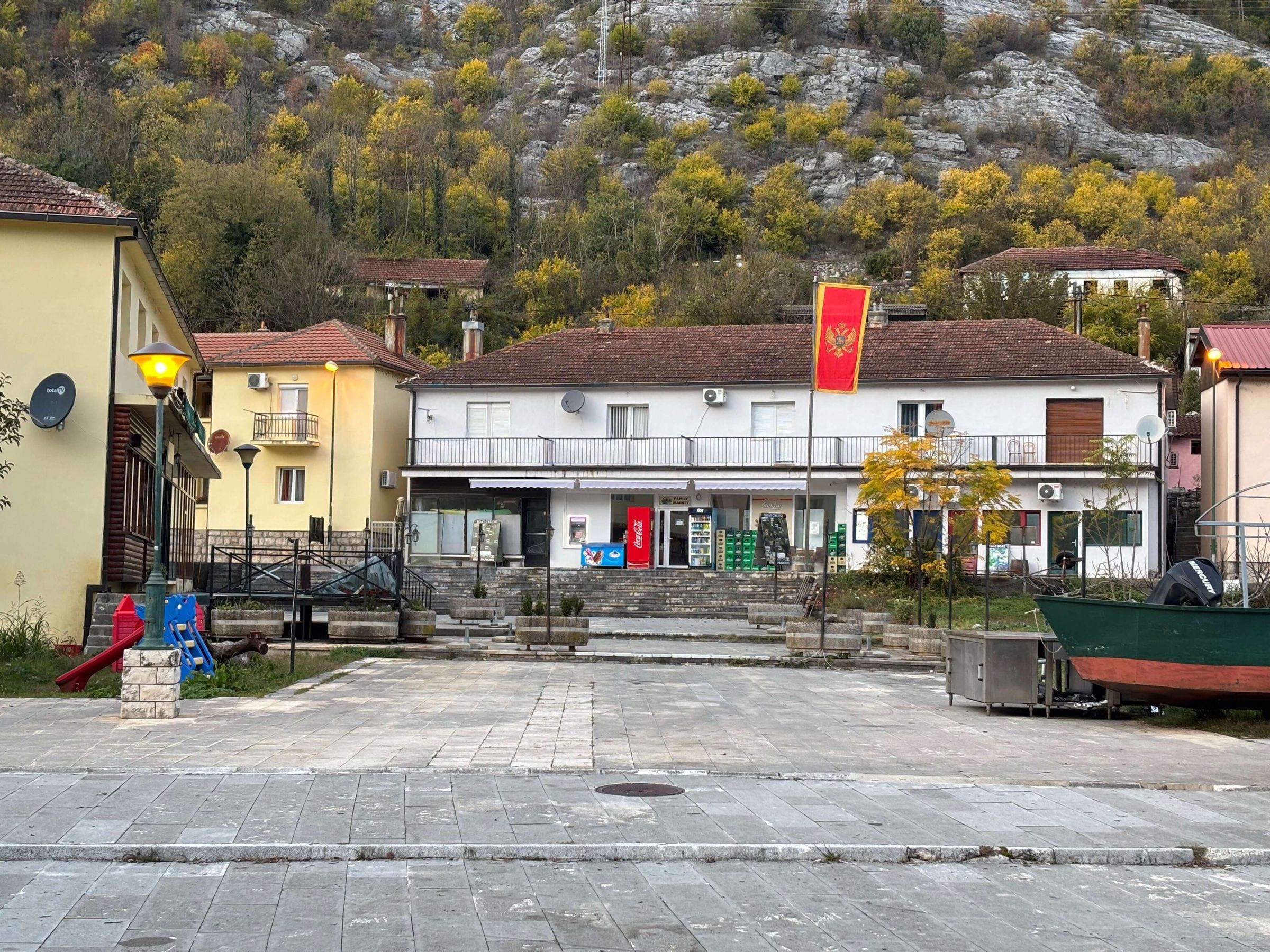
The modern village is tiny — a few hundred permanent residents — yet it draws a steady stream of visitors drawn by history, by the extraordinary beauty of the Lake Skadar shore, and by the particular quality of stillness that settles over old places whose moment of greatness has passed. The river remains clear and green. The stone bridge stands. Fishermen still put out onto the lake, as they have for centuries. In the hills above, the ruins of towers watch over a landscape that has changed enormously and, in certain essential ways, not at all.
The legacy of the Crnojevici dynasty and their printing press is commemorated at the Printing House Museum, which keeps alive the memory of those remarkable years in the 1490s when, against all historical odds, a small court on the edge of a Balkan lake chose to invest in books rather than simply survival — and by doing so, helped ensure that a culture and a language would survive the centuries that followed.
Rijeka Crnojevica is located within the Old Royal Capital Cetinje municipality in southwestern Montenegro, approximately 30 km from Podgorica. It lies within the Lake Skadar National Park. The Oktoih printed at Obod in 1494 is held in collections at the National Museum of Montenegro in Cetinje and several international institutions.