
O
Obod and the cave
A ruined fortress, a rebuilt church and a room linked to the first Cyrillic book printed among the South Slavs. About 2.5 km from the village, the river itself comes out of a cave.
History · Legends
Every old place has stories that are not quite history. Here are the ones told about the river and the bridge, with the facts set beside them.
Every old village has its stories. Some are history, with dates and documents. Others are legends: tales passed from one person to the next, changing a little each time.
This page is about the legends. Nobody can prove them, and that is not the point. They tell us what people here noticed, feared and loved. After each one, we set out what we actually know.
The first legend goes back to the time of Ivan Crnojević, the ruler who fortified Obod around 1475. It starts with a hunt.
Picture the moment. The hunters stand over their prize, pleased with the day. Then a low roar grows inside the hill, and the cave mouth fills with water. It is a good story: a strange animal, a sudden flood, and a river that seems to arrive all at once.
The legend explains something real: the river really does come out of the rock. It rises in Obodska pećina, the Obod cave, about 2.5 km south-west of the village, under a hill about 420 m high.
From there the river runs for about 12.3–13 km down to Skadar Lake. After its first kilometre, boats can travel on it. You can visit the cave yourself; read about it on Obod hill and cave.
The legend explains something real: the river really does come out of the rock.
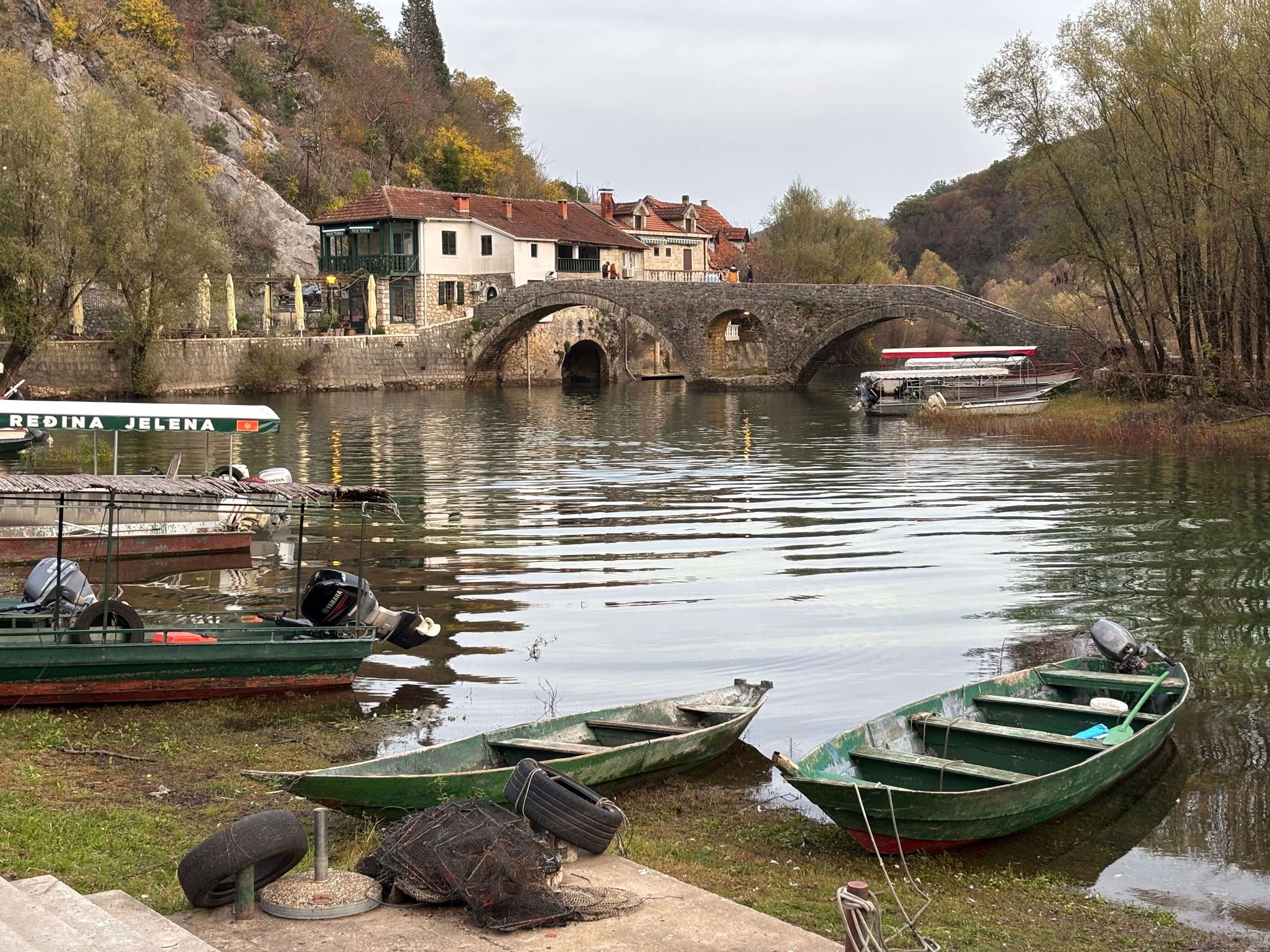
The second legend is younger. It belongs to Danilo’s Bridge, the stone bridge in the middle of the village. Prince Danilo built it in 1853 (some sources say 1855), in memory of his father, Stanko.
Imagine being one of those builders. You start again, stone by stone. Then comes the day when the scaffolding must come down a second time. Everyone holds their breath.
This time, the bridge held. It is still standing today.
Danilo’s Bridge is made of limestone. It is 43 m long and about 1.7–2 m wide. It has two large arches and two smaller openings that let flood water through. On the upstream side it has an icebreaker to protect it. The bridge has been a protected cultural monument since 1950.
Is the hook still there? We could not confirm whether you can still see the kučica on the bridge today. Ask in the village; someone will know the story, and perhaps the spot.
Not every story here is a legend. The village’s name is a piece of real history hiding in plain sight. Rijeka Crnojevića means “the River of the Crnojevićs”, the family who ruled here in the 15th century.
The old fortified town on Obod has a name of its own as well: Riječki grad, “the town of Rijeka”. You can read the family’s story in The Crnojević Dynasty and Obod.
People also give the village nicknames. The first is “Montenegrin Venice”, Crnogorska Venecija.
It is easy to see why the name stuck. This is a village of water and boats, with a stone bridge at its heart. In the 19th and early 20th centuries it was Montenegro’s main lake port and market, often described as the trade gateway to Cetinje. For a long time, life here moved at the speed of the river.
The second nickname is gentler, and a little sad: “sleeping beauty”.
The village did fall quiet. Regular shipping on the lake ended in 1981. In 1982 the main road between Titograd and Cetinje stopped running through the village, and decline began. In 1961 the village had 804 people. In 2023 it had 84.
But a sleeping beauty is not gone. She is waiting. The bridge still stands, the boats still go out, and people still come to hear the stories.
Legends are not lies, and they are not history either. They are the way a place remembers what matters to it.
Here, that seems clear. The river felt like a gift, sudden and powerful, so it got a story of its own. The bridge was hard to build, so its story is about fear and a second chance. Enjoy them as stories, and use the history timeline when you want the dates.
The facts on this page were checked against these sources.
Last verified: 3 October 2026. Spotted a mistake? Tell us
A ruined fortress, a rebuilt church and a room linked to the first Cyrillic book printed among the South Slavs. About 2.5 km from the village, the river itself comes out of a cave.
Two stone arches over a green river. Prince Danilo built this bridge in 1853 in memory of his father, and it still stands in the middle of the village.
We use Google Tag Manager for anonymous visit statistics, only with your consent.