
H
House of St Peter
Built between 1810 and 1815 as the winter home of Petar I, this is the oldest building in the village. Rijeka Crnojevića grew up around it.
History · 1810–1914
In the 1800s the village grew from a single winter house into Montenegro's main lake port, with steamers, a busy market and two new bridges.
Picture the valley in the winter of 1815. There is no stone bridge yet, no quay and no market. There is one new house, with smoke rising from its chimney. Everything else in the village came after it.
The House of St Peter of Cetinje was built between 1810 and 1815. It was the winter home of Petar I, whom Montenegrins remember as St Peter of Cetinje (Sveti Petar Cetinjski). It is also called Vladika’s House; vladika means bishop.
It is the oldest building in Rijeka Crnojevića, and the village grew around it. Later it became the region’s first sawmill. Today it belongs to the Obod monastery and has a chapel.
Before this, the river’s story belonged to the Crnojević rulers and their town on Obod hill. You can read it in the Crnojević dynasty and Obod. The Petrović century begins here, with one house.
Everything else in the village came after that one house.
In the 1830s and 1840s, Njegoš stationed the state guard, the Gvardija, in the village. We can imagine the guards on the bank, watching every boat that came up from the lake, and asking each boatman where he came from. Placing the guard here suggests that the village mattered to the state. At that time a wooden bridge crossed the river where the stone bridge stands today.
In 1842 an elementary school opened. Picture the first pupils on their way to class, past the guards and the boats. Down by the water, people were smoking and drying bleak (ukljeva), a fish from the lake (more about the river’s fish). According to Vuk Karadžić, this was done here since at least the 1830s.
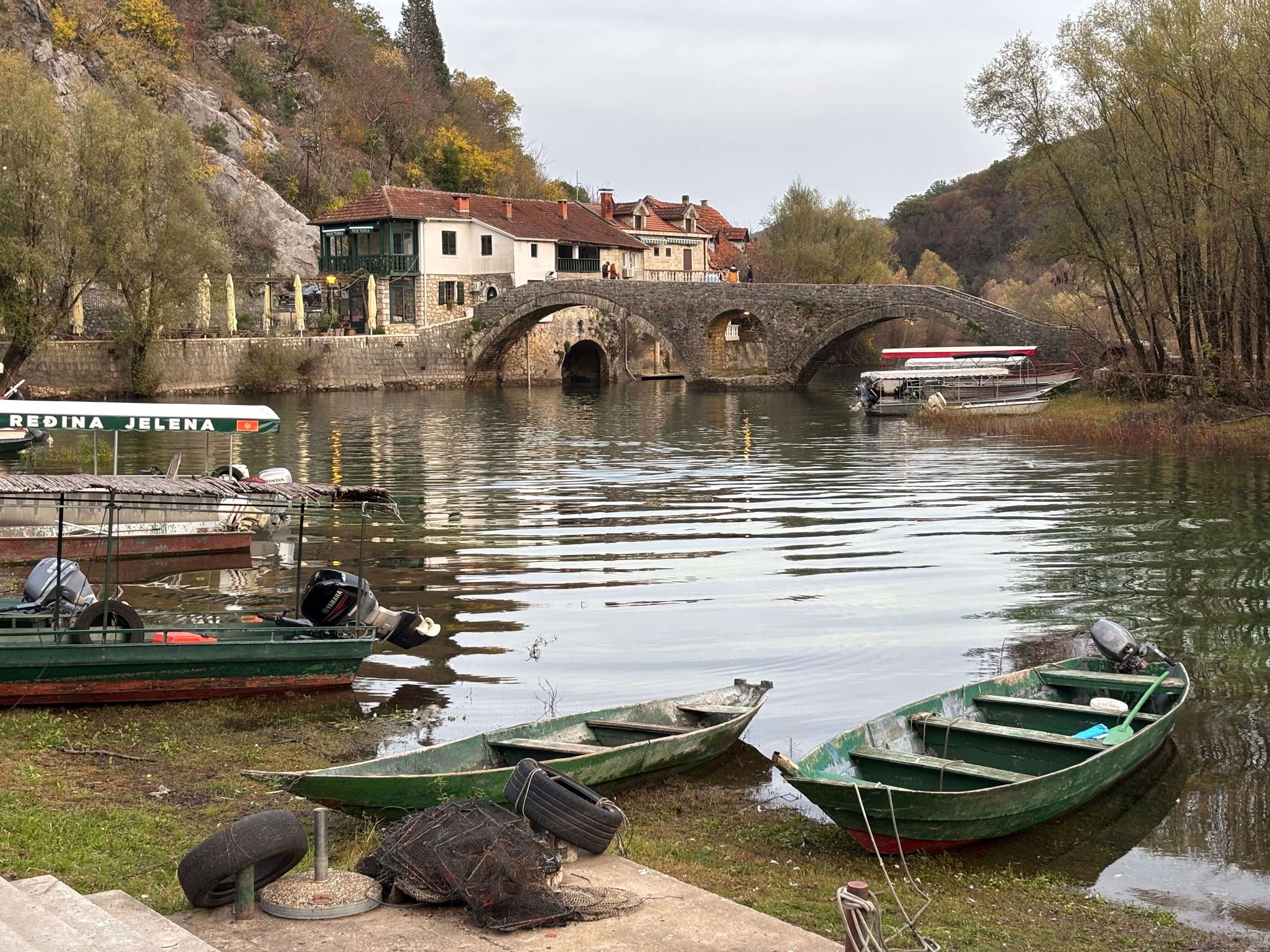
In 1853 Prince Danilo built a stone bridge across the river, in memory of his father, Stanko. We know it as Danilo’s Bridge (Danilov most). It is made of limestone and is 43 metres long. It has two large arches, two extra openings for high water, and an icebreaker on the upstream side.
If the legend is true, the building did not go smoothly. The story says the middle span fell when the scaffolding came down. Danilo had an iron hook, the kučica, fixed to one arch, with a grim warning to the builders: if the bridge fell again, he would hang them all. The full tale is in our legends.
Mostina is the house Prince Danilo built beside the bridge. The house and the bridge still stand side by side.
A war in 1862 ended with a peace imposed by the Ottomans. This is the 1862 peace (Convention of Scutari), which Montenegrin tradition links to Rijeka Crnojevića. For a small river village, that is a big name to carry.
In 1873 a sawmill opened. Our sources do not say whether it was the sawmill in the old House of St Peter.
In 1885 the steamer Žabljak started the first regular line on the lake. Imagine the first time its whistle sounded between the hills. By 1899 the steamers Mala Morača and Karatuna ran from here to Virpazar, Skadar and Plavnica. Boats still travel down the river to the lake today; see boat trips.
An account from 1899 gives us a clear snapshot. About 500 people lived here. There was a court, a telegraph, a post office and an arms workshop.
For a village of that size, it is a long list. The telegraph and the post office tied this small quay to the rest of the country.
The main export was dried bleak. Rijeka Crnojevića was Montenegro’s main lake port and market. It is often described as the trade gateway to Cetinje. Some people call it the “Montenegrin Venice” (Crnogorska Venecija).
We have no diary of a market day, so let us imagine one. A steamer whistles and edges up to the quay. Men carry sacks and crates ashore, and a clerk from the post office waits for the mail. Bundles of dried bleak are stacked for loading, and the air smells of smoke and fish.
Voices from the lake villages mix with voices from Cetinje. Someone hurries to the telegraph with news to send. Children run between the baskets, and a boatman shouts that he is leaving soon.
That is our picture. The facts behind it are simple: a port, a market, steamers and a great deal of dried fish.
In the 1880s King Nikola built a winter palace at Ljeskovac. The Church of the Ascension followed in 1889. Once again, the valley had a ruler’s winter home.
Today the palace is roofless and derelict. You can read what is left of it, and why its future is uncertain, on the Ljeskovac palace page.
In 1905 King Nikola built the New Bridge (Novi most). It is about 120 metres long and sits on the road towards Virpazar. It is still in use today. A prince and a king, two bridges, 52 years apart.
By the early 1900s the village had hotels: Evropa, Amerika and Obod. We do not know what they looked like or how many rooms they had.
We can only guess who slept in them: traders, officials, travellers waiting for the next steamer. The names, Europe and America, hint at big hopes for a small quay.
There was also a factory called “Marica”. It made mother-of-pearl products from fish scales. Here, even the scales of the fish found a use.
Much of this century is still there for you to see. Start at the House of St Peter, the oldest building in the village. Next, walk to Danilo’s Bridge and the house beside it, Mostina. Finally, find the New Bridge, about 120 metres long, on the road towards Virpazar.
The palace at Ljeskovac is the sad exception: it has lost its roof. The steamers are gone too. But the river they sailed is the same, and on a quiet morning it is not hard to hear the old port in your head.
By the early twentieth century, Rijeka Crnojevića was a real river town, busy with boats, trade and travellers. In the next century it grew bigger still, then slowly emptied, through war, a fish cannery and a long quiet. That story continues in the twentieth century.
The facts on this page were checked against these sources.
Last verified: 3 October 2026. Spotted a mistake? Tell us
Built between 1810 and 1815 as the winter home of Petar I, this is the oldest building in the village. Rijeka Crnojevića grew up around it.
Two stone arches over a green river. Prince Danilo built this bridge in 1853 in memory of his father, and it still stands in the middle of the village.
In the 1880s King Nikola built a winter palace at Ljeskovac. Today it has no roof, and its future is still undecided.
In 1905 King Nikola built the New Bridge, about 120 metres long. More than a hundred years later, it is still in use.
We use Google Tag Manager for anonymous visit statistics, only with your consent.