
Danilo's Bridge
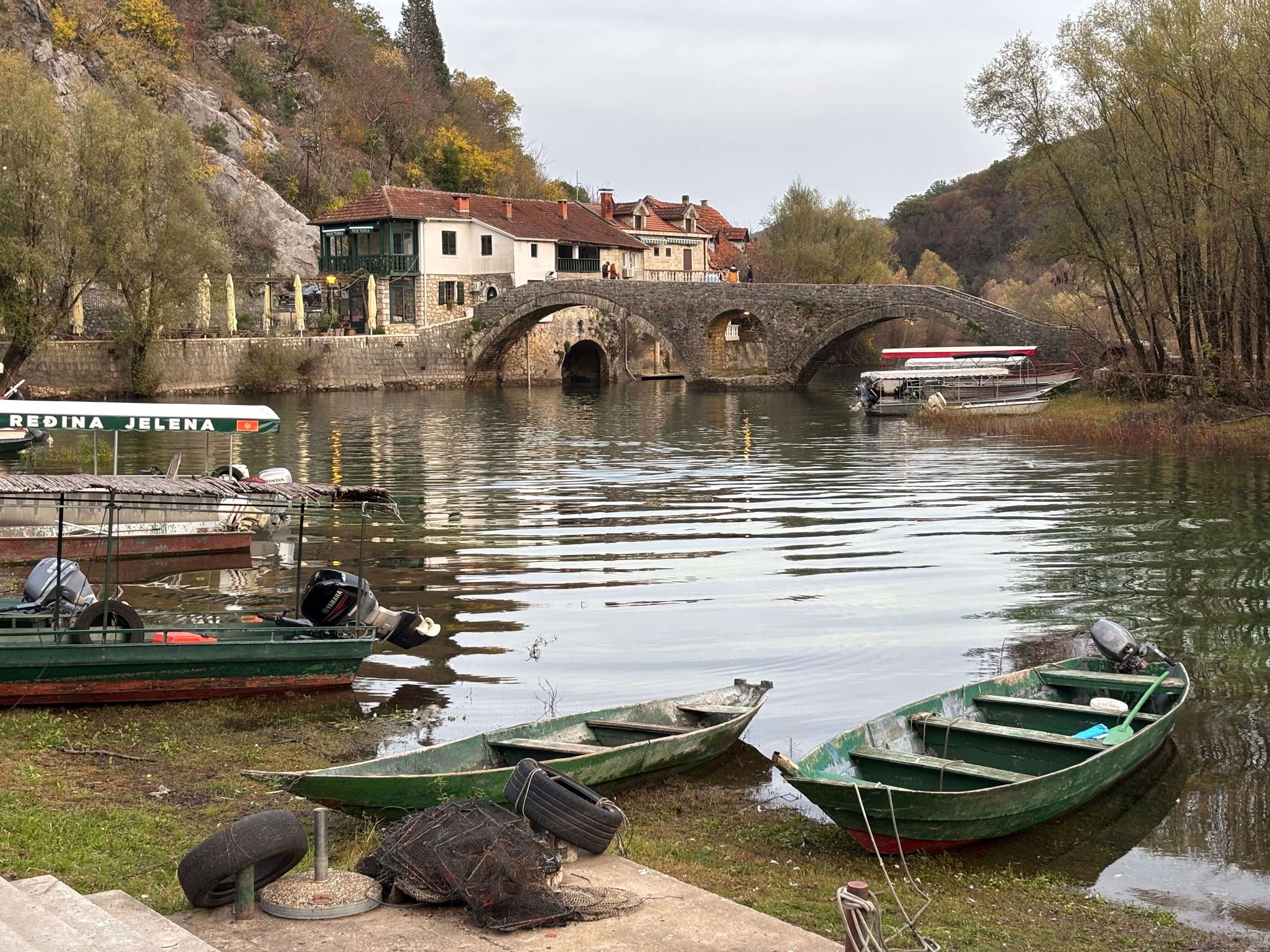
Two stone arches over a green river. Prince Danilo built this bridge in 1853 in memory of his father, and it still stands in the middle of the village.
Built between 1810 and 1815 as the winter home of Petar I, this is the oldest building in the village. Rijeka Crnojevića grew up around it.
Picture this valley two hundred years ago. There is no stone bridge yet, no school and no telegraph. Builders are at work on a house for Petar I. This is where he will spend his winters.
The house was built between 1810 and 1815 as the winter residence of Petar I, known today as St Peter of Cetinje (Sveti Petar Cetinjski). In Montenegrin it is Kuća Svetog Petra Cetinjskog. It is also called Vladika’s House; vladika means bishop. It is the oldest building in Rijeka Crnojevića, and the village grew up around it.
The dates that follow show a village taking shape. In the 1830s and 1840s, Njegoš kept the state guard, the Gvardija, here. A school opened in 1842. In 1853 Prince Danilo built the stone bridge that still stands today, Danilo’s Bridge. A wooden bridge had stood on that spot before; some sources say Petar I built it, others say Njegoš.
The story of these years, from Petar I to the busy steamer port, is told in the history of the Petrović-era river port.
Later, the house became the region’s first sawmill. We can imagine the change: where Petar I once spent his winters, saws now cut timber.
We do not know exactly when this happened. The village timeline records a sawmill opening in 1873, but our sources do not say whether it was the one in this house.
By 1899, the village that had grown up around this house had about 500 people. It had a court, a telegraph, a post office and an arms workshop, and steamers ran from it to Virpazar, Skadar and Plavnica.
Today the village is quiet again. In 2023 the census counted 84 people in 38 households. The oldest house in Rijeka Crnojevića has seen the whole story: the first winters of Petar I, the busy port years and the quiet that followed.
Today the house belongs to the Obod monastery, and it has a chapel. Obod has a long church history. In 1485 Ivan Crnojević gave a water mill at Obod to the monastery of St Nicholas. In 1692 the Ottomans destroyed the Obod monastery and built a mosque on the site. The Church of St Nicholas on Obod was rebuilt in 1743. You can walk to the church and the ruins of Ivan’s fortress on Obod hill.
Obod also has a place in the story of books: it is linked to the first state printing house among the South Slavs. The press began at Obod according to tradition; colophons, the notes printers put at the end of a book, place later printing at Cetinje. You can read more in the story of the Obod printing house.
We could not confirm whether the house or its chapel is open to visitors, or at what times. Look at the house from outside, and ask locally if you would like to see the chapel. If you are invited in, dress and behave as you would in any church.
The house is in the village, and you will find it on the map. Parking is free at the village entrance. There is no direct bus: take a bus to Cetinje or Podgorica, then a taxi. See Getting there for distances and tips.
While you are in the village, look at Danilo’s Bridge and the New Bridge, which King Nikola built in 1905.
The facts on this page were checked against these sources.
Last verified: 3 October 2026. Spotted a mistake? Tell us
Two stone arches over a green river. Prince Danilo built this bridge in 1853 in memory of his father, and it still stands in the middle of the village.
A ruined fortress, a rebuilt church and a room linked to the first Cyrillic book printed among the South Slavs. About 2.5 km from the village, the river itself comes out of a cave.
In 1905 King Nikola built the New Bridge, about 120 metres long. More than a hundred years later, it is still in use.
We use Google Tag Manager for anonymous visit statistics, only with your consent.